
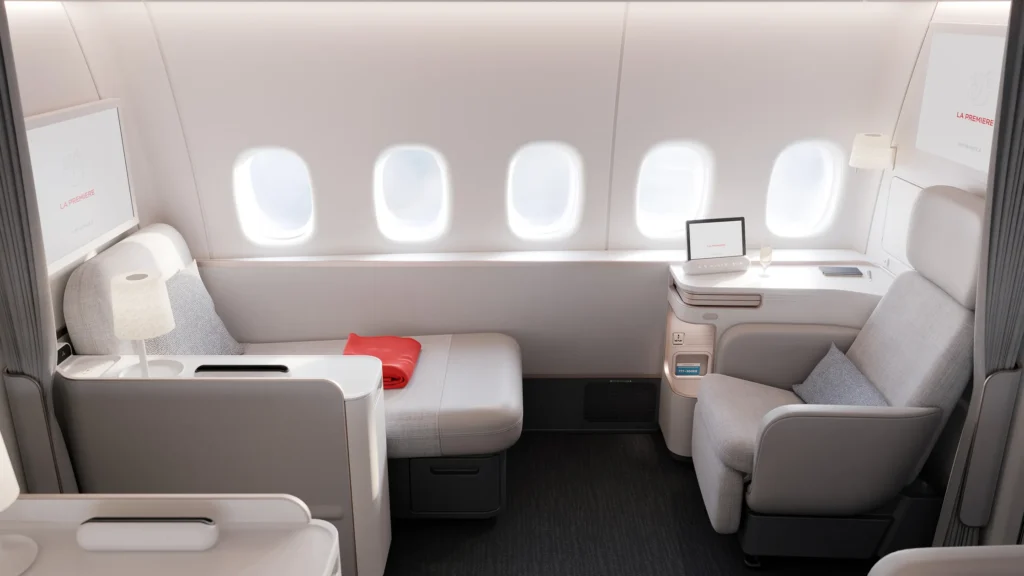
When booking your long-haul flight, you might start to daydream about lying down and sipping a glass of Champagne and enjoying your trip rather than counting down the minutes as you fight to fall asleep sitting upright in economy. But then you search for first-class flight prices and quickly land back in reality when you see that they can cost as much as a new car.
But here’s the secret the travel rewards community has known for decades: that seat doesn’t have to cost $15,000. While we’ve covered traveling luxuriously on a budget before, mastering your credit card points is the single most effective way to eliminate the cost of your airfare.
This guide will walk you, step by step, through exactly how to use everyday credit card spending to earn points, which cards to open to earn them fast, how to transfer those points to airlines, and how to actually book a lie-flat bed over the Atlantic (or the Pacific) for a fraction of the cash price. By the end, you’ll know which cards to get, how the points system works, and how to redeem for a first-class seat the right way.
Step 1: Pick a Destination First
The biggest mistake beginners make is hoarding points without a plan. Points are a currency, and just like real money, their value shifts dramatically depending on where you spend them. Before you apply for a single card, know roughly where you want to go, because that determines which airline programs (and therefore which credit cards) you should prioritize.
- Europe: Look toward Air France/KLM Flying Blue or Iberia Plus. JetBlue also now has Mint Class to Europe (read our JetBlue Mint Suites review here.)
- Japan: Virgin Atlantic miles can book ANA First Class at surprisingly low rates.
- The Middle East or Maldives: Qatar Airways Qsuites are widely considered the world’s best business-class product.
Expert Tip: Check which airlines fly from your home airport. If you live in a Delta hub like Atlanta, your strategy will look very different than if you’re flying out of a United hub like Chicago O’Hare.
Step 2: Understand the Three Types of Points

Not all points are created equal. Here’s the hierarchy you need to know:
- Airline Miles (e.g., Delta SkyMiles, United MileagePlus) are tied to one airline and its partners. They’re straightforward to use, but you’re stuck with whatever that airline charges, and some programs have notoriously poor value.
- Hotel Points (e.g., Marriott Bonvoy, Hilton Honors) are great for hotel stays, but generally transfer to airlines at terrible rates. Don’t rely on these for flights.
- Transferable Points are the gold standard. These are points earned through bank programs like Chase Ultimate Rewards, American Express Membership Rewards, or Capital One Miles. They’re the most powerful because you can move them to dozens of different airline and hotel programs depending on who’s offering the best deal at a given moment.
Beyond the points, many of these cards are also top-tier luxury travel memberships that offer automatic elite status and lounge access, making the airport experience as seamless as the flight.
Want to upgrade even further? Read our guide to The Most Affordable Semi-Private Airlines.
Step 3: Earn a Massive Welcome Bonus Fast
You could spend three years earning 1 point per dollar on your grocery bill. Or you could earn enough points for a first-class ticket in three months. The shortcut is the welcome bonus.
Banks routinely offer 60,000 to 150,000 points just for hitting a minimum spending requirement (typically $3,000–$6,000) in your first few months with a new card. For context, 75,000 points can book a one-way first-class seat to Japan.
Top starter cards to consider:
- Chase Sapphire Preferred: The best all-around beginner card. Earns Chase Ultimate Rewards points, which transfer to United, Hyatt, Air France, Singapore Airlines, and more. Current welcome bonuses often hit 60,000–80,000 points.
- American Express Gold Card: The best card for everyday spending. Earns 4x points at U.S. supermarkets and restaurants, making it easy to rack up Amex Membership Rewards points fast.
- Capital One Venture X: A premium travel card with a hefty welcome bonus and annual travel credits that effectively cancel out the annual fee for frequent travelers.
Step 4: Transfer Points to an Airline

Once you’ve earned your points, the most common beginner mistake is redeeming them through the credit card’s own travel portal (like Chase Travel or Amex Travel). You’ll typically get around 1–1.5 cents per point in value, which is fine for economy tickets, but a waste of your points’ true potential.
Instead, transfer your points directly to an airline loyalty program, then book the award ticket through that airline. This is where you’ll get the most bang for your buck. Airlines price first-class award seats in miles, and the rates are often set by partnerships that haven’t kept up with cash prices — meaning you can book a $10,000 seat for 75,000 points.
Here’s how the process works, step by step:
- Identify your route and airline. Decide where you’re flying and which airline operates a first-class product on that route.
- Check award availability. Log in to the airline’s website and search for “Saver” or “Standard” award seats on your dates. Availability varies, and flexibility helps quite a bit.
- Transfer your points. Once you confirm seats are available, go to your credit card’s rewards portal (Chase, Amex, or Capital One) and initiate a transfer to that airline’s loyalty program. Transfers are usually instant or take up to 24 hours.
- Book the award ticket. Return to the airline’s website and complete the booking using your newly transferred miles.
Important: Always confirm award seat availability before transferring points. Transfers are one-way and cannot be reversed.
Here are some of the best redemptions available right now:
| Airline | Typical Points Cost (One-Way) | What You Get |
| ANA First Class (to Tokyo) | ~75,000 points | Private suite, top-shelf whisky, full Japanese meal service |
| Lufthansa First Class | ~87,000 points | The First Class Terminal in Frankfurt, private Porsche escort to your plane |
| Qatar Qsuites (Business) | ~70,000 points | Closing doors, double beds — the world’s best business-class product |
Step 5: Keep Earning on Everyday Spending
Once you have your first card, optimize which card you use for each spending category:
- Dining & Groceries: Use a card that earns 3x–4x points (like the Amex Gold).
- Travel purchases: Use a card that earns 3x–5x on flights and hotels (like the Chase Sapphire Preferred or Reserve).
- Everything else: Use a flat-rate “catch-all” card that earns 2x on every purchase (like the Capital One Venture X).
Pro Tip: Stop paying with cash or debit. Every $5 coffee you buy with a debit card is a missed opportunity. Over a year of normal spending, the difference between a 2x card and a debit card can easily be 20,000–30,000 bonus points, which can be enough for a domestic first-class ticket.
Frequently Asked Questions
Does opening multiple credit cards hurt my credit score?
Opening a new card causes a small, temporary dip (typically 5–10 points) from the hard inquiry, and your average account age may drop slightly. However, your total available credit increases, which can actually improve your score over time by lowering your credit utilization ratio. As long as you pay your balance in full each month and don’t apply for too many cards in a short window, most people find their score rebounds within a few months and often ends up higher than before. Generally, spacing out applications by at least 3–6 months is a good rule of thumb. It’s also better for your credit score if you keep credit cards open for a long time. If you close them out immediately after cashing out your points, your score can take a hit.
Do points expire?
It depends on the program. Most airline miles expire after 18–24 months of account inactivity, meaning if you earn or redeem any miles, the clock resets. Credit card points like Chase Ultimate Rewards and Amex Membership Rewards generally don’t expire as long as your account stays open and in good standing. Always check the specific rules for each program you use.
Can I combine points from multiple cards?
Yes, in many cases. Chase Ultimate Rewards points can be combined across all your Chase cards. Amex Membership Rewards work similarly. This is one of the advantages of sticking to one bank’s ecosystem — you can pool points toward a single, bigger redemption.
What’s the best way to find available award seats?
Search directly on the airline’s website first. For more advanced searching, tools like Point.me or Seats.aero aggregate award availability across multiple airlines and programs, saving you hours of clicking through individual sites.
Is there an annual fee on these cards? Is it worth it?
Most premium rewards cards carry annual fees ranging from $95 (Chase Sapphire Preferred) to $695 (Amex Platinum). In nearly every case, the welcome bonus alone more than covers the first year’s fee. After that, evaluate the card’s ongoing credits and benefits. Many premium cards offer travel credits, lounge access, or hotel status that offset the fee entirely for frequent travelers.
Do I need to carry a balance to earn points?
No, and you should never carry a balance on a rewards card. The interest you’d pay would far exceed the value of any points earned. Always pay your statement balance in full every month. Rewards cards are only beneficial when used as a spending tool, not a loan.
Not enough points for a full suite yet? You can still get a horizontal night’s sleep by checking out United’s Relax Rows, which offer a lie-flat experience in the economy cabin.